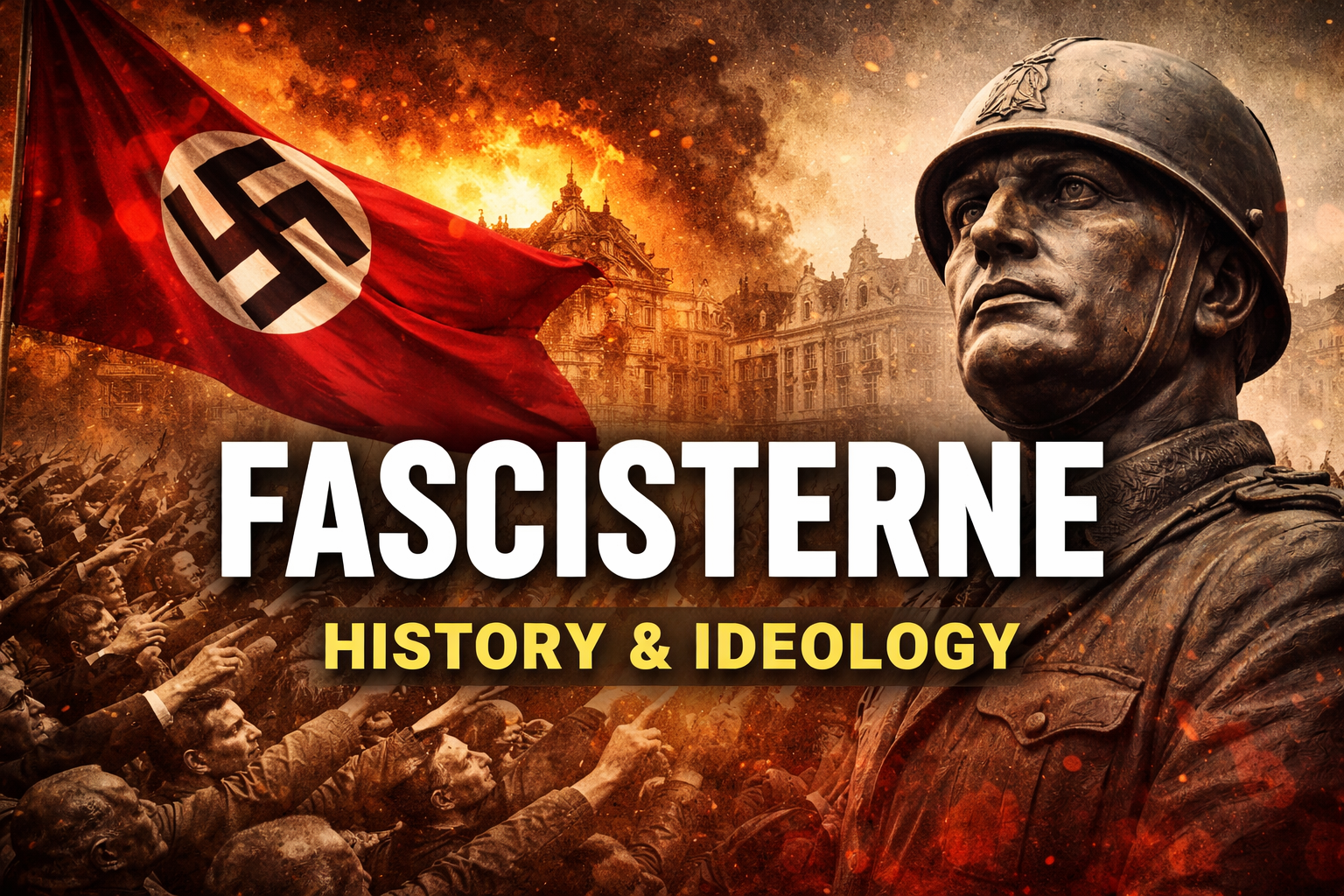
Fascisterne Explained: History, Ideas, and Real World Impact
The word fascisterne often appears in political discussions, historical writing, and modern debates about power, identity, and democracy. Many people encounter the term without a clear understanding of what it really means, where it comes from, or how it applies today. This confusion is understandable. Fascism is often used loosely as an insult or shorthand for authoritarian behavior, which strips the term of its historical and analytical meaning.
This article takes an informational, people first approach. It explains fascisterne in a clear and grounded way, rooted in historical evidence, academic understanding, and real world observation. The goal is not to persuade or provoke, but to inform. By the end, you should have a strong grasp of what fascisterne refers to, how fascist movements developed, why they gained support, and how their ideas continue to influence modern societies in subtle and overt ways.
Throughout this piece, I draw on established historical research, political theory, and my own experience analyzing extremist movements and political narratives across different cultures. Where certainty exists, I state it plainly. Where scholars disagree, that disagreement is acknowledged.
What Does Fascisterne Mean?
Fascisterne is a plural term commonly used in Scandinavian languages to refer to fascists as a group. It describes individuals or movements that adhere to fascist ideology, whether historically or in modern adaptations. While the word itself is linguistic, the ideas behind it are ideological and political.
At its core, fascism is a form of authoritarian nationalism. It promotes the idea that a nation is strongest when it is unified under a single identity, a strong leader, and strict social order. Individual freedoms are considered less important than collective strength, discipline, and loyalty to the state or nation.
Key elements associated with fascisterne include:
- Rejection of liberal democracy and pluralism
- Strong central authority led by a dominant figure
- Glorification of the nation, often tied to mythic history
- Suppression of political opposition and dissent
- Use of propaganda to shape public opinion
- Acceptance or promotion of violence as a political tool
It is important to note that fascism is not just about being conservative or patriotic. Many conservative systems support democratic institutions, rule of law, and civil rights. Fascisterne reject these limits when they are seen as obstacles to national strength.
Historical Origins of Fascism
Italy and the Birth of Fascist Ideology
Fascism as an organized ideology began in early twentieth century Italy. After World War One, Italy faced economic hardship, political instability, and social unrest. Many citizens felt betrayed by political elites and feared the rise of socialism and communism.
Benito Mussolini, a former socialist turned nationalist, capitalized on this fear and frustration. He presented fascism as a third path, rejecting both liberal democracy and Marxist socialism. His movement promised order, national pride, and a return to greatness.
Under Mussolini, fascism developed several defining traits:
- The state was portrayed as a living entity above individuals
- Political parties were eliminated in favor of one ruling movement
- Media was controlled to reinforce national narratives
- Violence was normalized through paramilitary groups
By the mid 1920s, Italy had become a one party dictatorship. This model inspired similar movements elsewhere in Europe.
Expansion Across Europe
Fascist movements spread rapidly in the interwar period. Economic collapse, fear of communism, and dissatisfaction with democratic governments created fertile ground.
The most infamous adaptation occurred in Germany under Adolf Hitler. While German National Socialism had distinct racial and antisemitic elements, historians broadly classify it as a fascist ideology due to its authoritarian structure, ultranationalism, and rejection of democracy.
Other countries saw fascist or fascist aligned movements, including Spain, Hungary, Romania, and parts of Scandinavia. These movements varied in intensity and success, but they shared core beliefs around hierarchy, national purity, and centralized power.
Core Beliefs That Define Fascisterne
Understanding fascisterne requires more than knowing historical events. It requires examining the beliefs that unify these movements across time and geography.
Authoritarian Leadership
Fascist systems elevate a single leader or ruling elite as the embodiment of the nation. This leader is presented as uniquely capable of restoring strength and order. Loyalty to the leader becomes synonymous with loyalty to the country.
Checks and balances are portrayed as weaknesses. Independent courts, free media, and opposition parties are seen as obstacles rather than safeguards.
Extreme Nationalism
National identity is central. Fascisterne promote a vision of the nation that is often exclusionary. Citizenship and belonging are tied to ethnicity, culture, or ideology rather than shared civic values.
This nationalism is emotional rather than rational. It draws on myths, symbols, and selective interpretations of history to create a sense of destiny and superiority.
Rejection of Liberal Values
Pluralism, minority rights, and individual freedoms are viewed with suspicion. Fascist ideology argues that diversity leads to division and weakness.
Freedom of speech is tolerated only when it supports the dominant narrative. Dissent is framed as betrayal.
Militarism and Glorification of Strength
Violence is not always the first choice, but it is accepted as legitimate. Military power, discipline, and sacrifice are glorified. War is often portrayed as a cleansing force that strengthens national character.
Why Fascist Movements Gain Support
A common mistake is assuming that only irrational or hateful people support fascism. History shows a more complex picture.
Economic Anxiety
Periods of economic instability create fear and resentment. When people lose jobs, savings, or social status, they often seek simple explanations and strong solutions.
Fascisterne exploit this by blaming internal or external enemies and promising rapid restoration of order.
Loss of Trust in Institutions
When democratic institutions fail to deliver security or fairness, public trust erodes. Corruption scandals, political gridlock, and inequality make authoritarian alternatives seem attractive.
Identity Crisis
Rapid social change can create anxiety about identity and belonging. Fascist movements offer clear answers, rigid roles, and a sense of purpose.
In my own analysis of modern extremist messaging, this appeal to identity is often more powerful than economic arguments.
Fascisterne in the Scandinavian Context
While fascism is often associated with southern and central Europe, Scandinavian countries were not immune.
During the 1930s and 1940s, several fascist and nationalist groups emerged in Denmark, Norway, and Sweden. These movements were generally smaller and less successful, but they shared ideological roots with broader European fascism.
In occupied Norway, collaborationist forces adopted fascist principles under German influence. Denmark saw nationalist groups that blended authoritarianism with cultural conservatism.
Post war, these movements lost legitimacy due to association with occupation and war crimes. However, elements of fascist ideology did not disappear entirely. They evolved, often rebranded under different labels.
Modern Adaptations of Fascist Ideas
Not Always Obvious
Modern fascisterne rarely present themselves using historical symbols or language. Instead, ideas are repackaged in ways that appear respectable or pragmatic.
Common strategies include:
- Framing authoritarian policies as security measures
- Redefining exclusion as cultural preservation
- Using democratic processes to weaken democracy from within
This makes identification more challenging.
Role of Media and Technology
Digital platforms have transformed how extremist ideas spread. Algorithms amplify emotionally charged content, while anonymity lowers social costs.
From my observation, modern fascist rhetoric often avoids explicit calls for dictatorship. Instead, it promotes distrust in institutions and glorifies strong leadership.
Distinguishing Fascism From Other Ideologies
Clarity matters. Not every authoritarian government is fascist, and not every nationalist movement fits the definition.
Key distinctions include:
- Communism emphasizes class struggle, fascism emphasizes national unity
- Traditional authoritarian regimes may lack mass mobilization
- Populism can exist without rejecting democratic norms
Fascisterne combine authoritarian power with mass emotional mobilization and nationalist mythology.
Real World Consequences of Fascist Rule
History provides clear evidence of what happens when fascist movements gain power.
Suppression of Freedom
Independent media, courts, and civil society are dismantled. Citizens lose the ability to challenge authority safely.
Persecution of Minorities
Exclusionary nationalism often leads to discrimination, forced assimilation, or violence against minorities.
War and Instability
Militarism increases the likelihood of conflict. Fascist regimes often pursue expansionist goals that destabilize regions.
These outcomes are not theoretical. They are documented across multiple countries and decades.
Can Democracies Resist Fascist Influence?
Yes, but it requires effort and awareness.
Strong institutions, civic education, and economic fairness reduce vulnerability. Transparency and accountability rebuild trust.
From my experience studying political resilience, the most effective defense is an informed population that understands how authoritarian narratives operate.
Ethical and Academic Debates Around the Term
Scholars debate how broadly the label fascisterne should be applied. Overuse can dilute meaning. Underuse can obscure danger.
Most agree on one point: the term should be used analytically, not casually. Precision protects credibility.
Common Misconceptions About Fascisterne
- Fascism is not limited to the past
- It is not always violent at first
- It does not require explicit dictatorship to function
Understanding these nuances helps prevent complacency.
Frequently Asked Questions
What is the simplest definition of fascisterne?
It refers to groups or individuals who follow fascist ideology, characterized by authoritarian nationalism, suppression of dissent, and centralized power.
Is fascism the same as dictatorship?
No. While fascist systems are authoritarian, not all dictatorships are fascist. Fascism involves mass mobilization and nationalist ideology.
Can fascist ideas exist in democratic systems?
Yes. Elements can exist within democracies, especially when institutions are weakened or norms erode.
Are all nationalist movements fascist?
No. Nationalism becomes fascist when it rejects pluralism, democracy, and individual rights in favor of authoritarian control.
Why do people support fascist movements?
Support often grows during times of fear, instability, or identity crisis, not simply due to ignorance or hatred.
Conclusion
Fascisterne represent more than a historical footnote. They embody a recurring pattern in human societies where fear, identity, and power intersect. By understanding their origins, beliefs, and consequences, we gain tools to recognize and respond to similar dynamics today.
This knowledge is not about labeling opponents or revisiting old conflicts. It is about clarity. History shows that when people understand how authoritarian movements operate, they are better equipped to defend open societies and human dignity.